7 Aralık 2012 Cuma

"Imperial Crime and Complicity In Ancient Rome and Modern America"

To contact us Click HERE
"Imperial Crime and Complicity In Ancient Rome and Modern America"
By Tim Case
"The punishment of the criminal is measured by the degree of astonishment of the judge who finds his crime incomprehensible." - Friedrich W. Nietzsche

"You would think that if the present administration with its adoring minions is going to rule by the Machiavellian code, as outlined in the “The Prince”, they would at least take to heart the admonition that "as princes cannot help being hated by someone, they ought, in the first place, to avoid being hated by every one, and when they cannot compass this, they ought to endeavor with the utmost diligence to avoid the hatred of the most powerful." That is unless Obama et al. are convinced that all the dissension and anger is nothing more than the cries of the 'idiot du village'; which seems to be the case.

Just before he died, Herodian of Antioch reports that the Roman Emperor Marcus Aurelius cautioned his son, Commodus, and the young man’s advisors: "…No amount of money is large enough to compensate for a tyrant's excesses, nor is the protection of his bodyguards enough to shield the ruler who does not possess the good will of his subjects. The ruler who implants in the hearts of his subjects not fear resulting from cruelty, but love occasioned by kindness, is most likely to complete his reign safely… It is not those who submit from necessity but those who are persuaded to obedience who continue to serve and to suffer without suspicion and without pretense of flattery. And they never rebel unless they are driven to it by violence and arrogance…"

As most know the death of Marcus Aurelius transferred to his young son, Commodus, the full title of emperor. Dio Cassius tells us that Commodus was "not naturally wicked but, on the contrary, as guileless as any man that ever lived. His great simplicity, however, together with his cowardice, made him the slave of his companions, and it was through them that he at first, out of ignorance, missed the better life and then was led on into lustful and cruel habits, which soon became second nature." Regardless of his character, Commodus had not heeded his father’s words. As such his unrestrained brutality aroused massive unrest resulting in, among other things, a civil war which aided in a continuing erosion of the empire’s stability and prosperity.

Herodian confirms for us that Commodus’ end came when it was discovered that he had sentenced his loyal, loving mistress, Marcia; his praetorian prefect, Laetus; his bedroom steward, Eclectus, and a long list of prominent senators to be put to death. Marcia "poured the poison into the cup, mixed it with a pungent wine, and gave it to him to drink. Since it was his practice to take a cup of friendship after his many baths and jousts with animals, he drained it without noticing anything unusual." Afraid that Commodus would somehow live, Marcia, Laetus and Eclectus also persuaded a young nobleman, by the name of Narcissus, to strangle the emperor, just to be sure he really died. The legacy of Commodus is fittingly coupled with his body being unceremoniously removed from the Imperial palace wrapped in bed linen as just another bundle of dirty laundry, then placed in a common wagon and taken to the outskirts of the city. It is what happened next that has a lesson for us today.

Wanting to save their lives, because they had murdered Commodus, but also desiring to place a man on the throne that would rule Rome justly, Laetus and Eclectus settled on the most venerated of Commodus’ advisors and native-born Italian by the name of Pertinax. Pertinax had never sought the purple robe and had had no part in any conspiracy against the emperor. Of Pertinax it can rightfully be said that he served both Marcus Aurelius and Commodus honorably. Even so, when Laetus came with Eclectus to Pertinax’s estate to offer him the position of emperor, his first reaction was to serenely accept the fact that Commodus had sent Eclectus and Laetus to kill him.

"For a long time now," Pertinax said, "I have been waiting for my life to end in this fashion, and I was surprised that Commodus was so slow to act against me, the sole survivor of the advisers his father appointed for him. Why do you delay? You will be carrying out your orders, and I will be relieved from degrading hope and constant fear." It took some time, but Laetus and Eclectus eventually convinced Pertinax they were not there to take his life, but rather to offer him the Roman throne. This, they argued, was because of his age, proven wisdom, distinguished service as a senator and his love for justice.

As word of Commodus’ death spread the Roman people reacted as if the Roman Empire had suddenly found itself translated upward into orbit in the empyrean. Herodian of Antioch explains: "When these events became known, the people milled about in a frenzy of joy, like men possessed, and everyone took delight in telling the news to his neighbors, especially if they happened to be men of wealth and position, for Commodus was particularly dangerous to such men. Rushing to the temples and altars, the people united in giving thanks to the gods, shouting all sorts of things: ‘The tyrant is dead!’ ‘The gladiator is slain!’ and other blasphemies more scurrilous. All the insults which had hitherto been left unsaid through fear were now voiced openly, with freedom and safety restored."

The Praetorian Guard was not nearly as easily swayed, but due to the passion of the people, the Praetorian Guard’s knowledge of Pertinax’s courage, his temperate life, his honorable military service, and his acceptance among the troops on the empire’s frontiers, they reluctantly accepted Pertinax as emperor. But first they had to be persuaded that Commodus’ death hadn’t been murder. It fell to the Praetorian Prefect, Laetus, to address the Praetorian Guard and put their suspicions to rest. Laetus did exactly that with these words: "Commodus, your emperor, is dead of apoplexy. In a case of this kind, the blame can be put on no one else. The emperor was responsible for his own death. He paid no attention when we urged him time and again to adopt a safer and saner course. You know the way he lived his life. Now he lies dead, choked by his own gluttony. The death he was destined for has overtaken him at last. As you are aware, the cause of death is not one and the same for all men. The most diverse causes bring us to life's inevitable outcome…"

It was a lie but it roused the people to the point that they accepted it as fact, and while the praetorians were still not convinced, they realized they were surrounded by a mass of the people, and the people had decided the issue by declaring Pertinax their new emperor. Even with the backing of the people, and the unenthusiastic consent of the Praetorian Guards Pertinax wasn’t sure that the Roman senators would be willing to confirm him as emperor. His concern resided not in his own safety but rather the "abrupt change from the autocracy of Commodus, and about the noble ancestry of certain of the senators. He suspected that these senators, after having been ruled by the most nobly born of all the emperors, would not be willing to let the reins of government fall into the hands of a man who came to the high office from humble and undistinguished antecedents."

Pertinax’s worries were put to rest when the senate enthusiastically accepted him, then conferred on him the full title of emperor along with "every honor and every token of respect." The senators then accompanied their new emperor to the temple of Jupiter and the rest of the shrines, subsequently completing their journey by ushering Pertinax into the imperial palace. What Emperor Pertinax did to try and right the Roman Empire in the next three months can only be described as extraordinary.

Pertinax’s first act was to curb the praetorian’s arrogant, cruel treatment of people. He outlawed their carrying of axes (probably the fasces) and their arbitrary striking of anyone they wished. This order "delighted the older people, and won the good will of the others without difficulty..." Pertinax’s sense of justice freed the people from the savage and oppressive tyranny of which they had become accustomed, allowing them to again live a relaxed, efficient life. The unique sense of justice exhibited by Pertinax included the banishing of informers who had been accustomed to stealing property by false witness. He even went to extraordinary lengths to see to it that no one could be threatened by false accusations, and to prosecute those who engaged in such practices.

On the domestic front the emperor also banned the unjust tolls; "fees collected at the banks of rivers, the harbors of cities, and the crossroads," allowing people the freedom of movement that had been restricted under Commodus. More importantly "Pertinax assigned all the land in Italy and the rest of the provinces not under cultivation, to anyone willing to care for it and farm it, to be his own private property; he gave to each man as much land as he wished and was able to manage, even if the land were imperial property. To these farmers he granted exemption from all taxes for ten years and freedom from government duties as well." The emperor would not allow "his name to be stamped on imperial property, stating that these effects were not the emperor's personal property but the common and public possessions of the Roman Empire."

Pertinax’s sense of justice also had international repercussions. Herodian confirms that "… the mildness of his rule became known everywhere, all nations subject to Roman rule or friendly to the Romans, and all the armies in the field as well, came to regard his reign as that of a god." Even the "barbarians who were formerly restless and rebellious mindful of his brilliant achievements in his previous campaigns, feared him and willingly submitted to him. They put their trust in his reputation for never purposely doing an injustice and always treating every man according to his deserts; improper conduct and savage violence were completely foreign to his nature. Embassies from all countries came to him, and everyone delighted in the rule of the Romans under Pertinax."

Certainly it doesn’t take much imagination to realize what effect the domestic and foreign policies of Pertinax would have on domestic and foreign markets. There must have been an unbridled joy, coupled with a new enthusiastic fervor that swept over the import businesses along with permeating every sector of economic endeavor. We will never know what Emperor Pertinax’s strategies would have had on the decaying Roman Empire. His sense of justice and sound fiscal plan had made his powerful enemies among the imperial bodyguard angry. Those who had habitually supplemented their income through lies, mugging and pillage were not to be denied. The praetorians "who, being accustomed to live licentiously under Commodus," writes Machiavelli, "could not endure the honest life to which Pertinax wished to reduce them; … having given cause for hatred, to which hatred there was added contempt for his old age" one day they assaulted the Imperial palace and murdered Emperor Pertinax.

The life flowing from the old emperor is equally symbolic of the life ebbing from Old Rome. This one act doomed the empire to years of military despotism, massive inflation and economic failures only to be exacerbated, codified and finally culminated in the edicts of Diocletian. The instruction that can be gleaned from Pertinax’s short reign is almost legion. Beyond the obvious danger that is faced by all those good men and women who seek to reestablish justice and economic stability through government, there exists a far more ominous admonition.

For far too long we have allowed ourselves to be deluded into thinking that our fight resides with and is encompassed within the framework of political and social ideologies. As such we use labels such as right and left; liberal and conservative; or socialist and communist to define either foes or ourselves. It is time we realize that these labels are smoke screens designed to justify and persuade us as to why we should be plundered. Historically the real battle resides not in philosophical gibberish, but in the reality within society that there are powerful criminal elements that will always seek to justify their self-serving, selfish need to rob, maim, imprison and murder others. The conflict always has been between criminal action of the few and the resistance (and/or lack of it) by the mass of intended victims.

Pertinax is reported to have told the Roman senate on the day he was received as emperor, "…Those who have grown accustomed to reveling in the extravagant excesses of a tyranny not only object to any change toward a more moderate and more economical way of life occasioned by a shortage of money, not terming it sensible economy or planned and judicious management, but they reject it as a mean and wretched way to live, oblivious to the fact that had it not been for the loot taken by pillage and plunder, they could never have enjoyed their luxurious way of life."

Until the people of this nation become enraged at the brutal illicit activities being forced on them, the human, social and legal condition of the United States will continue to be consumed by a voracious criminal element with the same rapaciousness which was experienced by Roman society after the death of Emperor Pertinax. In case you were wondering, the Roman people did riot for a few days after they learned of Pertinax’s murder, but the Praetorian Guard simply hid in their compound until the people settled down and accepted their fate. This took the Roman people from the state of victimization, to that of being complicit in their own destruction."- http://www.marketoracle.co.uk/Article18972.html
- http://www.lewrockwell.com●Tim Case is a 32-year student of the ancient histories who agrees with the first-century stoic Epictetus on this one point: “Only the educated are free.”

Chet Raymo, "Extraordinary Claims Require Extraordinary Evidence"

To contact us Click HERE
"Extraordinary Claims Require Extraordinary Evidence"
by Chet Raymo
"There have been so many books lately proffering "proof of heaven" one could almost call it a fad. Seems like everyone and his brother has had a near death experience that gave them a short sojourn in paradise. And a book contract. Am I being cynical? I suppose so. I do wonder though why no one ever has a near death experience of the other place. A book called "Hell Is For Real". Who's going to buy that?

The latest contender is different. Dr. Eben Alexander came to the heavenly feast with credentials as a neurosurgeon. His book, Proof of Heaven, describes (say reviews) his out-of-body experiences during a period when his neo-cortex was apparently shut down during a life-threatening medical emergency. He was met on the other side by a beautiful blue-eyed woman who took him for a ride on butterflies. He saw a shining orb he understood to be a loving God.

I don't doubt Dr. Alexander's sincerity, but I would take issue with what seems to be his central "proof," according to the press: There is no way science can explain his experience. There are lots of things that science can't (yet) explain, but that doesn't mean Dr. Alexander's soul went to heaven. Science can't explain much about the brain, not least what happens in crisis mode. I would let Ockham's Razor attribute the beautiful blue-eyed woman and butterflies to Dr. Alexander's brain before I'd invoke the journey of an immaterial soul to an afterlife and back- and on to the best-seller list, a Newsweek cover, and an Oprah special.

And while I'm on the subject, let me mention a novel I just read by my friend Michael Wilt, "The Holy Family". The protagonist of Wilt's story doesn't experience proof of heaven. Rather, he makes a journey in the opposite direction, from devout Catholic to cautious atheist. It's a gentle journey, without rancor or rebuke. At the heart of the story is a tragedy that might send a less courageous person running for the comfort of Dr. Alexander's book, but Wilt's protagonist and his spouse find consolation for their loss in the miracle of life itself.

I could wish for Michael bestsellerdom and an Oprah special, but I have the feeling that his novel is too full of doubt and searching and pain and tenderness- all of the things that define the human adventure in the absence of True Belief. No ultimate answers, no "proof" of everlasting life, only the ties of human love that in this best of all available worlds bind us to one another.”- http://blog.sciencemusings.com/

“Blue Skies: The Sky Is Blue Even on a Cloudy Day”

To contact us Click HERE
“Blue Skies: The Sky Is Blue Even on a Cloudy Day”
by Madisyn Taylor, The DailyOM
“Darker days are just as much a part of life as are the days graced with sunshine. When we refer to a “beautiful day,” we are often describing a day that is sunny, clear, and without a cloud in sight to mar a sky that is a brilliantly perfect blue. We find ourselves bouncing along, light in spirit, free from worries, and enjoying the moment. That is, until the clouds begin to form. The sky may turn grey, and a fog may roll in. Puffs of white take on whimsical, darker shades, and our beautiful day disappears along with the sunshine… or so it seems.

A clear blue sky often inspires in us good cheer, bringing on a lighter, more carefree day. We may find ourselves spending time outdoors, breathing in the fresh air, and basking in the warmth of the sun. Yet should clouds appear to wash the sky with shadows, we may let this change of weather decrease our energy and enthusiasm, pulling us into our own cloudy funk. Darker days are just as much a part of life as are the days graced with sunshine. They show us a different perspective of our world, while helping us appreciate the moments of illumination that inevitably follow. A rainy day with clouds helps to clear the air, washing away stagnation. Still, it’s hard not to feel gloomy or think that the day has been ruined when there are clouds hanging over us. Yet if you can remember that these shades of grey won’t last forever, and that hidden behind the clouds is the blue sky, you will find that the beauty of your day is merely playing a game of peek-a-boo with you. Like the mishaps and interruptions that occasionally block the brilliance that is our own lives from shining through, clouds eventually clear away so we can open up to a brighter horizon.

The next time you wake up to a cloudy day, remember that these shades of grey in life are there just for the moment.  And that no matter how hard the rain falls or how chilly the fog is, the clouds will go away, the sun will break through, and you will be able to see the sky that has always and forever been a beautiful and brilliant blue.”- http://www.dailyom.com/

Paulo Coelho, "The Good Fight"

To contact us Click HERE
"The Good Fight"
by Paulo Coelho
"In 1986, I went for the first and only time on the pilgrimage known as the Way to Santiago, an experience I described in my first book. We had just finished walking up a small hill, a village appeared on the horizon, and it was then that my guide, whom I shall call Petrus (although that was not his name), said to me: "We must never stop dreaming. Dreams provide nourishment for the soul, just as a meal does for the body. Many times in our lives we see our dreams shattered and our desires frustrated, but we have to continue dreaming. If we don’t, our soul dies.

The Good Fight is the one we fight because our heart asks it of us. The Good Fight is the one that’s fought in the name of our dreams. When we are young our dreams first explode inside us with all of their force, we are very courageous, but we haven’t yet learned how to fight. With great effort, we learn how to fight, but by then we no longer have the courage to go into combat. So we turn against ourselves and do battle within. We become our own worst enemy. We say that our dreams were childish, or too difficult to realize, or the result or our not having known enough about life. We kill our dreams because we are afraid to Fight the Good Fight.

The first symptom of the process of killing our dreams is lack of time. The busiest people I have known in my life always have time enough to do everything. Those who do nothing are always tired and pay no attention to the little amount of work they are required to do. They complain constantly that the day is too short. The truth is, they are afraid to Fight the Good Fight…

The second symptom of the death of our dreams lies in our certainties. Because we don’t want to see life as a grand adventure, we begin to think of ourselves as wise and fair and correct in asking so little of life. We look beyond the walls of our day-to-day existence, and we hear the sound of lances breaking, we smell the dust and the sweat, and we see the great defeats and the fire in the eyes of the warriors. But we never see the delight, the immense delight in the hearts of those engaged in the battle. For them, neither victory nor defeat is important; what’s important is only that they are Fighting the Good Fight.

And, finally, the third symptom of the passing of our dreams is peace. Life becomes a Sunday afternoon; we ask for nothing grand, and we cease to demand anything more than we are willing to give. In that state we think of ourselves as being mature; we put aside the fantasies of our youth, and we seek personal and professional achievement. We are surprised when people our age say that they still want this or that out of life. But really, deep in our hearts, we know that what has happened is that we have renounced the battle for our dreams- we have refused to Fight the Good Fight.

When we renounce our dreams and find peace, we go through a period of tranquility. But the dead dreams begin to rot within us and to infect our entire being. We become cruel to those around us, and then we begin to direct this cruelty against ourselves. What we sought to avoid in combat- disappointment and defeat- came upon us because of our cowardice. And one day, the dead, spoiled dreams make it difficult to breath, and we actually seek death. It’s death that frees us from our certainties, from our work, and from that terrible peace of Sunday afternoons."- http://paulocoelhoblog.com/

The Universe

To contact us Click HERE
“If you frequently give yourself permission to doodle, wander, and be totally unproductive, and you actually relish such interludes, I can guarantee that your genius, creativity, and productivity will increase exponentially. I've seen it happen a billion times. Operative words, were "frequently," "permission," and "relish"; does not work with "stingily," "regret," and "guilt."
“Through the roof,”
    The Universe

“Thoughts become things... choose the good ones!”
www.tut.com

30 Kasım 2012 Cuma

Where Does Money Come From? The Giant Federal Reserve Scam That Most Americans Do Not Understand

To contact us Click HERE
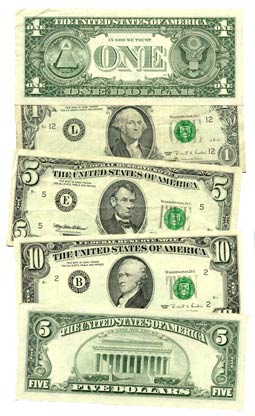
How is money created?  If you ask average people on the street this question, most of them have absolutely no idea.  This is rather odd, because we all use money constantly.  You would think that it would only be natural for all of us to know where it comes from.  So where does money come from?  A lot of people assume that the federal government creates our money, but that is not the case.  If the federal government could just print and spend more money whenever it wanted to, our national debt would be zero.  But instead, our national debt is now nearly 16 trillion dollars.  So why does our government (or any sovereign government for that matter) have to borrow money from anybody?  That is a very good question.  The truth is that in theory the U.S. government does not have to borrow a single penny from anyone.  But under the Federal Reserve system, the U.S. government has purposely allowed itself to be subjugated to a financial system in which it will be constantly borrowing larger and larger amounts of money.  In fact, this is how it works in the vast majority of the countries on the planet at this point.  As you will see, this kind of system is not sustainable and the structural problems caused by such a system are at the very heart of our debt problems today.So where does money come from?  In the United States, it comes from the Federal Reserve.When the U.S. government decides that it wants to spend another billion dollars that it does not have, it does not print up a billion dollars.Rather, the U.S. government creates a bunch of U.S. Treasury bonds (debt) and takes them over to the Federal Reserve.The Federal Reserve creates a billion dollars out of thin air and exchanges them for the U.S. Treasury bonds.So why does the U.S. government go to all this trouble?  Why doesn't the U.S. government create the money itself?Those are very good questions.One of the primary reasons why our system is structured this way is so that wealthy people can get even wealthier by lending money to the U.S. government and other national governments.For example, last year the U.S. government spent more than 454 billion dollars just on interest on the national debt.Over the centuries, the ultra-wealthy have found lending to national governments to be a very, very profitable enterprise.The U.S. Treasury bonds that the Federal Reserve receives in exchange for the money it has created out of nothing are auctioned off through the Federal Reserve system.But wait.There is a problem.Because the U.S. government must pay interest on the Treasury bonds, the amount of debt that has been created by this transaction is greater than the amount of money that has been created.So where will the U.S. government get the money to pay that debt?Well, the theory is that we can get money to circulate through the economy really, really fast and tax it at a high enough rate that the government will be able to collect enough taxes to pay the debt.But that never actually happens, does it?And the creators of the Federal Reserve understood this as well.  They understood that the U.S. government would not have enough money to both run the government and service the national debt.  They knew that the U.S. government would have to keep borrowing even more money in an attempt to keep up with the game.That is why I call the Federal Reserve a perpetual debt machine.  The Federal Reserve was created to trap the U.S. government in an endlessly expanding debt spiral from which there is no escape.And the Federal Reserve is doing a great job at what it was designed to do.  Today, the U.S. national debt is more than 5000 times larger than it was when the Federal Reserve was first created.Another way that money comes into existence in our economy is through the process of fractional reserve banking.I originally pulled the following simplified explanation of fractional reserve banking off of the website of the Federal Reserve Bank of New York, but it has been pulled down since then.  But I still think it is helpful in understanding the basics of how fractional reserve banking works....
"If the reserve requirement is 10%, for example, a bank that receives a $100 deposit may lend out $90 of that deposit. If the borrower then writes a check to someone who deposits the $90, the bank receiving that deposit can lend out $81. As the process continues, the banking system can expand the initial deposit of $100 into a maximum of $1,000 of money ($100+$90+81+$72.90+...=$1,000)."
When you put your money into the bank, it does not say there.  The bank only keeps a relatively small amount of money sitting around to satisfy the withdrawal demands of account holders.  If all of us went down to the banks right now and demanded our money, that would create a major problem.If I put 100 dollars into the bank and the bank lends out 90 of those dollars to you, now it looks like there are 190 dollars floating around.  I have "100 dollars" in my bank account and you have "90 dollars" that you just borrowed.The new debt that you have taken on (90 dollars) has "created" more money.  But of course you are going to end up paying back more than 90 dollars to the bank, so more debt has been created than the amount of money that has been created.And that is one of the big problems with our financial system.  It is designed so that the amount of debt and the amount of money are supposed to be perpetually expanding, and the amount of debt created is always greater than the amount of money that is created.So is it any wonder that our society is swamped with nearly 55 trillion dollars of total debt at this point?A debt-based financial system is unsustainable by nature because it will always create debt bubbles that will inevitably burst.Are you starting to see why so many Americans are saying that we need to abolish the Federal Reserve system?Our founding fathers never intended for our financial system to work this way.According to Article I, Section 8 of the U.S. Constitution, the U.S. Congress is supposed to have the authority to "coin Money, regulate the Value thereof, and of foreign Coin, and fix the Standard of Weights and Measures".So why has this authority been given to a private institution that is dominated by the big Wall Street banks and that has actually argued in court that it is "not an agency" of the federal government?Thomas Jefferson once said that if he could add just one more amendment to the U.S. Constitution it would be a ban on all government borrowing....
I wish it were possible to obtain a single amendment to our Constitution. I would be willing to depend on that alone for the reduction of the administration of our government to the genuine principles of its Constitution; I mean an additional article, taking from the federal government the power of borrowing.
But instead, we have become enslaved to a system where government borrowing actually creates our money.The borrower is the servant of the lender, and we have allowed our government to enslave us to the tune of nearly 16 trillion dollars.There are alternatives to this system.  Things do not have to work this way.Unfortunately, the vast majority of our politicians consider the Federal Reserve to be good for America and steadfastly refuse to do anything to change the status quo.So if you are waiting for "solutions" to these problems on the national level you are going to be waiting for a very long time.The debt problems that the United States and Europe are experiencing did not come into existence by accident.  They are the result of fundamental structural problems with the financial system.A debt-based financial system is always going to fail in the long run.  Unfortunately, most Americans still do not understand this and so we will all get to suffer the consequences.

Our Outlook for Utilities Stocks 'Til death do us part: Merger partners now tied, but power prices still deadly. (By Travish Miller - Morning Star)

To contact us Click HERE
  • Although natural gas and power prices stabilized in the second quarter, they remain at levels that are compressing margins for coal and nuclear power producers. 
  • Utilities are still doing exceedingly well with mergers this cycle as Northeast Utilities and Exelon closed their multibillion-dollar deals last quarter. Duke appears set to close its merger by July after receiving key federal go-ahead. 
  • The sector's average 4.2% dividend yield still offers a historically attractive spread over U.S. Treasuries, suggesting regulated utilities could continue their phenomenal three-year run. 

For several quarters now, utilities investors have woken to the same story. Low interest rates continue to offer an impressive tailwind for utilities that can drive earnings higher with low borrowing costs and offer investors attractive dividend yields with growth. But market-exposed power producers continue to suffer from persistently low power prices that are compressing margins for coal and nuclear operators.
For regulated utilities, the near-term outlook remains bright even as valuations stretch well beyond historical norms. A group of the 31 largest U.S.-regulated utilities returned 5% between March and June, handily beating the S&P 500's negative 3.5% return and all 11 market sectors, yet have trailed nearly all other sectors year to date. For utilities that can avoid punitive regulation, we think investors could still realize 4%-6% dividend growth to go with near-4% yields.
For power producers, fundamental changes are taking hold in power markets as coal plant shutdowns accelerate, natural gas generation skyrockets, and reserve margins face dangerous tightening during the next three to five years. We now count 35 GW of planned or executed coal plant shutdowns since late 2010, up from 30 GW last quarter and closing in on our 53 GW estimate. Gas generation in March hit its highest share of total U.S. generation in at least 40 years at 30%, while coal's share fell to its lowest level at 34%, based on the most recent government data. In May, the Texas grid operator's semiannual long-term outlook projected state reserve margins tightening below its target range as soon as next summer.
Industry-Level Insights
Languishing power and gas prices continue to weigh on earnings for diversified utilities and power producers. Year to date, gas prices are down 13% and power prices are down 6%. We now think earnings for most utilities with power market exposure will hit troughs in 2013-14. Coal plant operators are facing shrinking dividend coverage, liquidity concerns, and even restructuring from compressed margins and fast-approaching environmental compliance requirements.
We believe political and regulatory uncertainty are depressing power and capacity prices. Two key environmental regulations finalized in 2011 face legal challenges and political uncertainty going into the November elections. We believe power prices reflect very little of the full impact we expect from these regulations. Political intervention also appears to be depressing capacity values for emissions-controlled and clean incumbent generators. Subsidized projects in New Jersey and Maryland cut 2015-16 Mid-Atlantic capacity prices in half from our normalized estimates for certain regions, and New York is assessing subsidized generation options. Depressed power and capacity prices hurt utilities such as Exelon (EXC), GenOn Energy (GEN), and NRG Energy (NRG) the most because of their large exposure to competitive power markets.
Even if power, gas, and capacity prices stay low, we think tighter power markets and increased reliance on gas generation could lead to more volatile power prices. This should favor the largest, most diversified utilities such as Exelon, NRG Energy, and FirstEnergy (FE). These utilities moved early to pair their wholesale generation with a growing retail supply business. This pairing gives them a cost and liquidity advantage over other retailers, offering a rare competitive advantage that could lead to industry consolidation and margin expansion. Exelon in early June projected $100 million of revenue synergies from its combination with Constellation's retail business. NRG Energy is realizing similar benefits in Texas.
For all utilities, we think regulatory risk remains the key threat. The 770-basis-point spread between recently awarded allowed returns and U.S. Treasury rates is the widest in at least 20 years and 190 basis points above the 20-year average. Mean reversion would hit earnings hard. Merger approval also has been difficult, albeit successful. Regulators required rate credits, rate freezes, and/or commitments to uneconomic investments before approving Northeast Utilities' (NU) $9.5 billion acquisition of NSTAR and Exelon's $7 billion acquisition of Constellation, both of which closed this spring. These concessions will make it difficult for the companies to create value from the deals.
Similarly, Duke Energy's (DUK) $17.9 billion acquisition of Progress Energy (PGN) appears set to close by July 1, but only after the companies offered enough concessions to receive sign-off from federal regulators. Entergy's (ETR) proposed acquisition of ITC Holdings (ITC) also faces a difficult regulatory path.
Our Top Utilities Picks
 
On a market-capitalization-weighted basis, the average sector price/fair value ratio is 0.87, down from 0.90 last quarter. But the utility sector's 1.05 median price/fair value still highlights the sharp valuation divide we see between the relatively cheap, large diversified utilities and the relatively pricey, smaller regulated utilities.
Only two of the 33 regulated utilities we cover are trading below our fair value estimates as of mid-June. Yet paradoxically, dividend yields and growth prospects for many of those utilities still look attractive. The spread between the 4.2% utility sector average dividend yield and 10-year U.S. Treasuries at 260 basis points is the widest in at least 20 years, and most domestic utilities have no exposure to Europe's financial woes. For safety-minded, yield-seeking investors, we continue to point toward National Grid (NGG), American Electric Power (AEP), and Alliant (LNT).
Among diversified utilities and independent power producers, we still favor those with low-emissions baseload generation assets like Exelon and Ormat Technologies (ORA). As power markets tighten, we think GenOn Energy, NRG Energy, and Public Service Enterprise Group (PEG) can be winners.